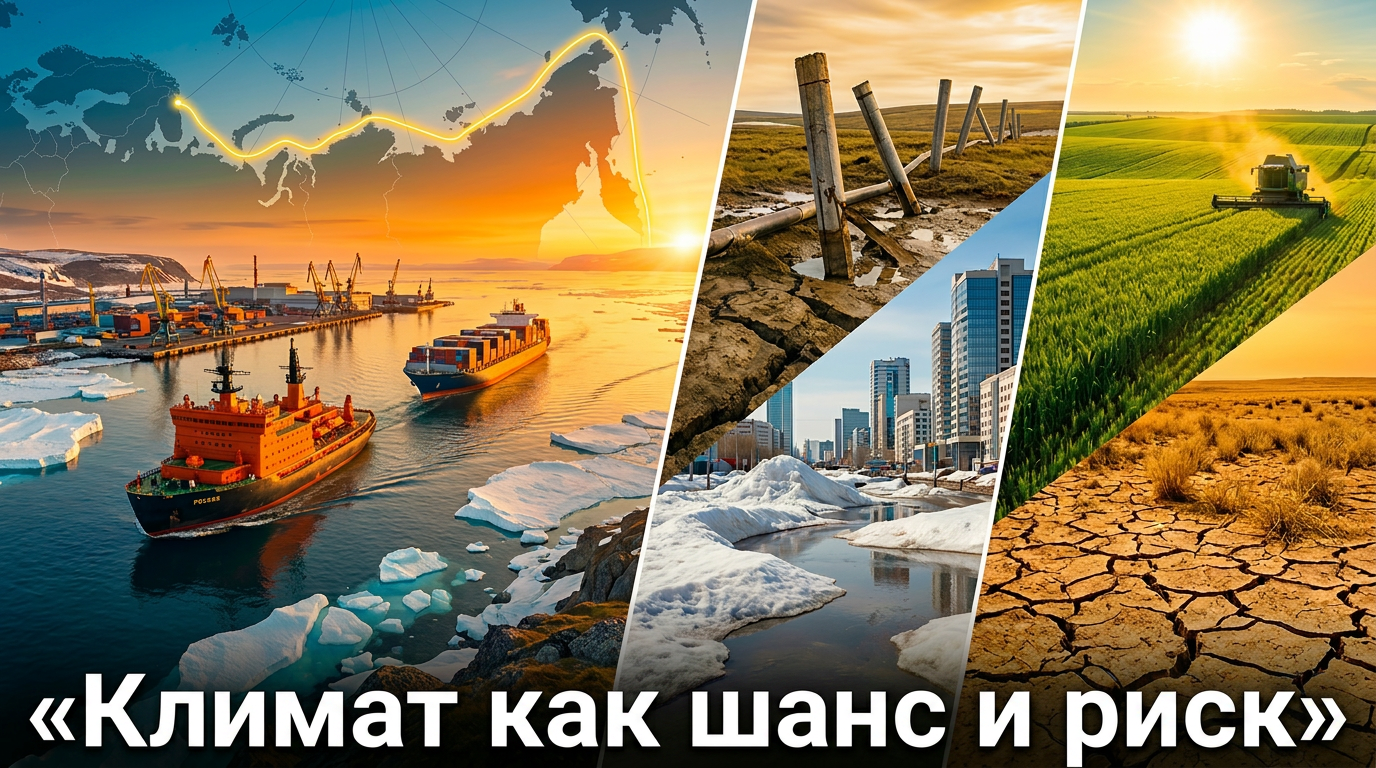
The world’s coldest country is warming faster than any other. Over the next half-century, Russia is set to gain an additional 2.5°C in average annual temperature. This is not an environmental statistic. It is a redistribution of resources, trade routes, and demographics. Climate change alters a nation’s geopolitical weight not through sudden catastrophes, but through a slow shift in where people can live, work, and do business.
What This Story Is Really About
Historically, Russia has been at a disadvantage compared to its rivals on one fundamental parameter: cold made everything more expensive. Grain, metal, logistics—the cost of production in a northern climate was always higher than that of its warmer competitors. Warming is changing this structural weakness. For the first time in centuries, the country with the largest territory on Earth is catching a climatic tailwind. The question is whether it can harness that wind before it turns into new costs.
Three Shifts That Will Change Everything
Arctic transit. By 2040–2050, at current melting rates, the Northern Sea Route will become a fully functional commercial artery—a shorter alternative to the Suez Canal for trade between Asia and Europe. Russia controls most of this route. Whoever holds the transit route gets a seat at the table where the rules are written.
The agricultural climate shift. The wheat belt is moving north. Western Siberia and several northern districts of European Russia will gain new opportunities. Meanwhile, southern zones—the Krasnodar region, the Lower Volga—will face intensifying heat waves of up to 40–45°C and more frequent droughts. The balance of agricultural production inside the country will shift. This will require either investment in adaptation or a redistribution of resources.
Infrastructure losses. Thawing permafrost, which underlies 65% of Russian territory, means the degradation of foundations, pipelines, and roads across Siberia. According to researchers, by 2050, the share of the population living in climatically unfavorable zones will rise from 9% to 13–15%. That spells internal migration, a restructured labor market, and new budget priorities.

Forecast: Where the Configuration Is Headed
The next decade will be a transition period. Climate costs are already rising, but the benefits have not yet materialized. Infrastructure losses in the permafrost zone and rising insurance risks in the south will hit the budget before the Arctic and new agricultural zones begin to pay off.
By 2040–2050, the configuration changes. Provided Russia maintains its icebreaker fleet and coastal infrastructure, the Northern Sea Route becomes a genuine geopolitical asset—especially if tensions around southern shipping chokepoints persist. Russia will find itself the gatekeeper of an alternative trade route at the very moment when demand for it is at its peak.
By 2060–2075, the key issue will be demography. Warming will expand the zones where living is comfortable, but without a deliberate national policy, there will be no one to fill them. An empty, warming expanse invites foreign interests faster than it attracts its own population. This is no longer a climate problem. It is classical geopolitics: space without people is not a resource—it is a vulnerability.
What to Do If You Think Strategically
Climate change creates an asymmetry of opportunity that is already quantifiable. Arctic logistics, northern agriculture, Siberia’s water resources—these are not futuristic fantasies. They are a 15-to-20-year horizon. Positions in these sectors are being staked out now, while they are still not obvious to everyone. Whoever enters first sets the rules. Whoever arrives second pays someone else’s price.
![[node:title]](/web/sites/default/files/styles/max_325x325/public/field/image/33c89197-c846-4a52-bdf2-c73342525694.png.webp?itok=JbrUSLx0)
![[node:title]](/web/sites/default/files/styles/max_325x325/public/field/image/140a205e-a285-4969-b5df-4eb7ab8612b4.png.webp?itok=Qy_BBj3u)






.png)
.png)

.png)
.png)