
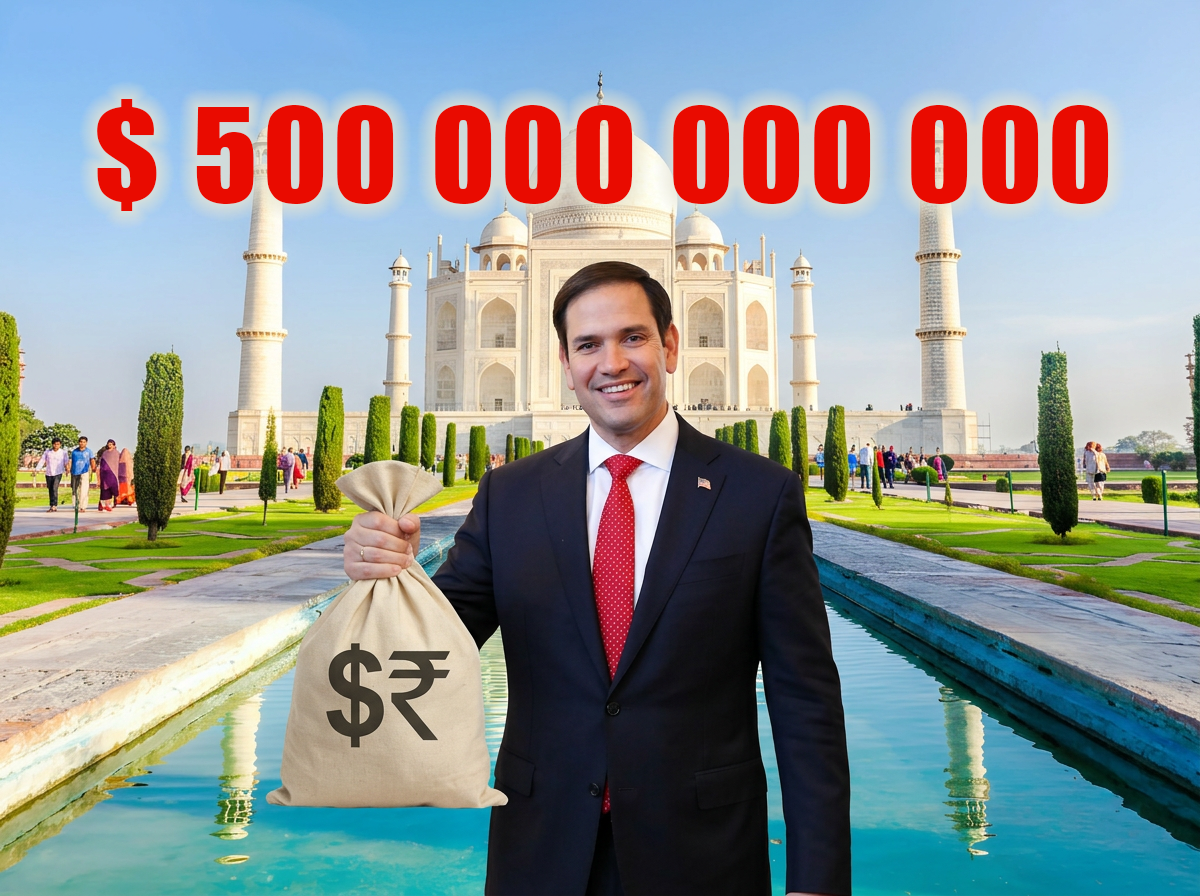
When the U.S. Secretary of State declares that the crowning diplomatic achievement of a high-profile visit is not a new alliance commitment or a landmark joint declaration, but a promise to purchase half a trillion dollars' worth of American goods — that tells you something. Not about Indian foreign policy. About American.
What This Story Is Really About
Washington has been systematically turning trade deals into the currency of geopolitical loyalty. First Saudi Arabia, then Japan, now India. The logic is consistent: access to the American market and Washington's political favor are being monetized through procurement packages. This is not trade in any classical sense — it is the structured purchase of allied alignment.
India, for its part, is negotiating from a position of considerable strength. Over the past year, Washington managed to strain ties with New Delhi through tariff disputes, while simultaneously making a conspicuous move toward Pakistan — via its mediation role in Iran talks — all while continuing its careful balancing act with China. For New Delhi, the message was clear: the price of Indian loyalty had gone up. And India presented the bill accordingly.
Has America Lost Its Competitive Edge?
The question is worth asking. The United States has spent decades methodically deindustrializing, offshoring production to China and Southeast Asia. Today, American exports remain competitive in a handful of niches: liquefied natural gas, defense hardware, semiconductor technology, and agricultural commodities. Not coincidentally, these are precisely the sectors at the heart of the deal — energy, technology, agriculture.
That is no accident. These are the segments where the U.S. still holds either a physical advantage or technological leverage. Everywhere else — consumer electronics, industrial equipment, everyday goods — American exports lost ground long ago. When the central argument in negotiations shifts from "our product is better" to "buy this much and we'll call you an ally," that is an acknowledgment of a structural shift.
The Strait of Hormuz: An Open Question
Secretary Rubio cited progress in negotiations over the Strait of Hormuz, immediately qualifying it: any resolution requires "full acceptance and compliance" by the Iranian side. The diplomatic translation is straightforward — there is no deal, only an American position that Tehran has yet to accept in full.
For India, the Hormuz question is existential: a significant share of its oil imports transits the strait. Any instability there is a direct blow to the Indian economy. That is precisely why New Delhi has as much stake in American security guarantees for the strait as Washington has in Indian procurement commitments.
Outlook: Where the Configuration Is Heading
Five hundred billion dollars over five years is not a contract — it is a political commitment. Actual purchase volumes will be shaped by market conditions, pricing, and whether Indian companies ultimately find American offerings competitive. Saudi Arabia made comparable pledges; delivery has consistently lagged the headline figures.
Strategically, what matters more is the broader pattern: India is methodically positioning itself as an indispensable partner to multiple power centers simultaneously — the United States, Russia, and the Gulf states. This allows New Delhi to convert geopolitical multi-alignment into concrete economic advantages. It is a model that other major players are already beginning to replicate.
What to Watch
For Russian business, India's pivot toward American procurement is not a catastrophe — but it is a signal. India remains a pragmatic partner that buys Russian oil at a discount while simultaneously striking deals with Washington. That is not a contradiction; it is Indian strategy. Engaging with such a partner requires a clear-eyed approach: no illusions about exclusivity, but a precise understanding of where Russia holds pricing and logistical advantages that no American political package will overcome.




.png)
.png)

.png)
.png)